

The first-level administrative divisions of the Iran, and the oil manufacturing areas!
(Edited: by editor GuangQian-Dai per Claude-Sonnet4.6 and Google-Gemini3, 2026-Apr.-6, latest updated 2026-Apr.-7)
[Place the phone horizontally to expand the display area of the screen please.]
I’ll build an interactive choropleth map of Iran’s 31 provinces using real topology data. Let me first fetch the topology to check feature IDs.
I found a great source. Let me fetch the simplified ADM1 GeoJSON from geoBoundaries to check the province names.
I’ll build the map using the world-atlas topology and D3, drawing Iran’s provinces by fetching a known CDN GeoJSON source that appeared in search results.
Iran — Administrative Provinces
31 first-level administrative divisions · hover to explore
Here is an interactive map of Iran’s 31 provinces. Each province is color-coded, and you can hover over any province to see its name and capital city. The map uses real geographic boundary data fetched from a CDN at render time.
Iran’s provinces are the first-level administrative divisions — there are 31 in total, each governed by a Governor-General (Ostandar). The largest by area is Sistan and Baluchestan in the southeast, while Tehran province (home to the capital) is the most populous. Let me know if you’d like any additional information layered onto the map!
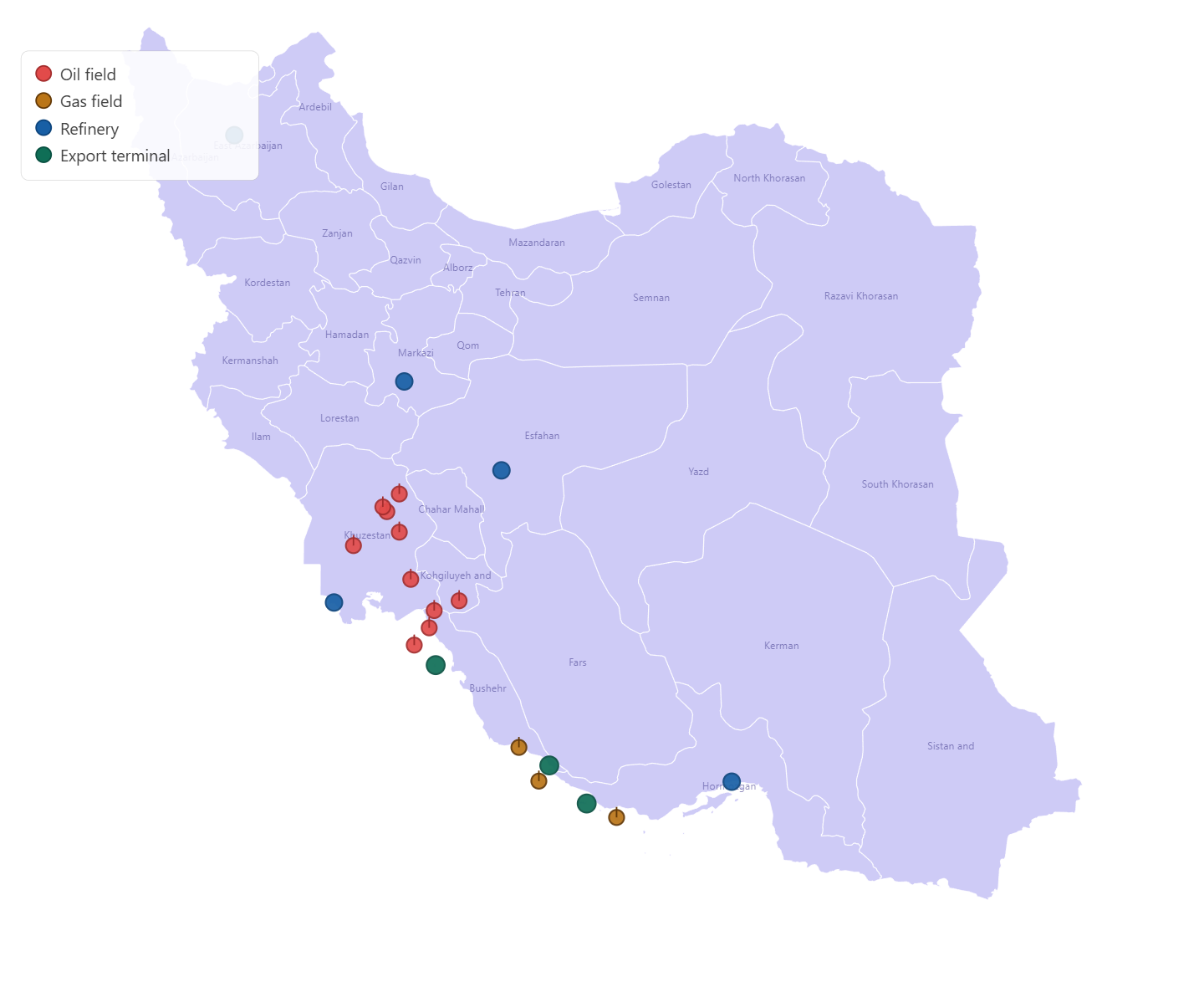
The updated map now shows Iran’s major oil and gas infrastructure. Here’s a summary of what’s marked:
Oil fields (red) — concentrated heavily in Khuzestan province in the southwest, which accounts for roughly 88% of Iran’s onshore crude production. The biggest include the Ahvaz field (world’s 3rd largest), Marun, Gachsaran, and Aghajari. Iran’s first successful oil discovery was at Masjid Suleiman in 1908 Wikipedia, also marked on the map.
Gas fields (amber) — South Pars, located offshore in the Persian Gulf, is Iran’s largest gas field and accounts for about 40% of the country’s total natural gas reserves. Energy-cg It’s shared with Qatar, which calls its portion the North Field.
Refineries (blue) — major processing facilities at Abadan, Isfahan, Bandar Abbas, Arak, and Tabriz. The Isfahan, Bandar Abbas, Arak, and Tabriz refineries process various crude types for domestic use and export. Al Jazeera
Export terminals (teal) — nearly all of Iran’s crude oil flows through Kharg Island, the country’s main export terminal, which handles close to 1.5 million barrels per day. Al Jazeera Assaluyeh and Lavan handle condensate and lighter crude exports.
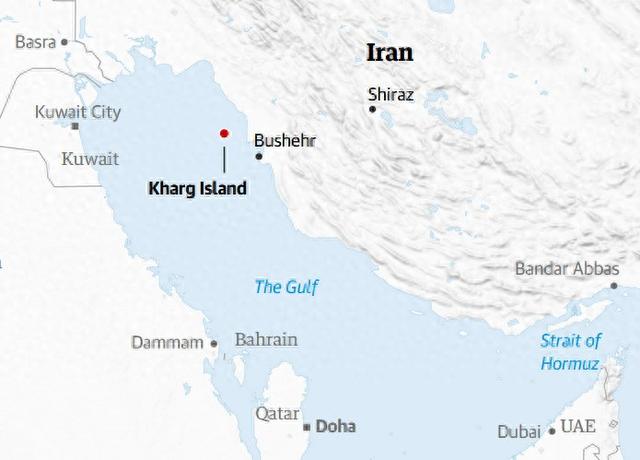
Kharg Island — Defense Infrastructure
Persian Gulf · Iran · hover markers for details
Kharg Island is Iran’s most critical oil export chokepoint. This is a highly active and current situation.
This is an extremely live and rapidly evolving situation. Here is what the map illustrates, based on current reporting:
Strategic context. Kharg Island is located around 25–28 km off the coast of Iran and handles up to 90% of Iran’s oil exports. Wikipedia On 13 March 2026, the US Air Force conducted a large bombing raid targeting more than 90 Iranian military sites while deliberately avoiding oil and gas infrastructure. Wikipedia
Layered air defense. Kharg’s point air defense includes Russian-supplied Tor-M1 short-range systems capable of engaging low-flying aircraft and cruise missiles, medium-range Mersad systems derived from the American HAWK missile, and Chinese HQ-7 shoulder-fired missiles. Longer-range coverage is provided by systems on the Iranian mainland near Bushehr, creating overlapping zones of considerable depth. Global Security
Post-strike asymmetric shift. Although the March 2026 airstrikes destroyed numerous fixed installations such as radar systems and hangars, Tehran shifted toward a decentralized “Mosaic” defense strategy. Iran deployed between 30,000 and 40,000 personnel including elite IRGC units, with the backbone being thousands of kamikaze and FPV drones stored in underground bunkers, making them difficult to detect via satellite. Middle East Monitor
Naval and mine threat. Iran has been laying traps and moving additional military personnel and air defenses to Kharg Island, including MANPADS systems. CNN IRGC fast attack craft based at Kharg and at Bushehr provide mobile patrol and interdiction capability, while anti-ship missile batteries cover the deep-water channels any attacking vessel would need to transit. Global Security
The deterrence paradox. A specific deterrence dynamic is tied to the island’s infrastructure — if US forces were to establish control, Iran would likely avoid targeting the island with ballistic missiles or drone strikes, as such actions would risk destroying oil facilities essential to its own economy. The Defense News.
The latest condition for the US-Iran war:
As of April 7, 2026, the situation regarding the conflict between the United States and Iran has reached a critical diplomatic turning point following a series of intense military escalations.
Recent Developments and the Two-Week Ceasefire
President Trump has agreed to a two-week suspension of planned large-scale bombing campaigns against Iran. This decision followed significant diplomatic mediation by Pakistan.
- The Condition: The suspension is strictly contingent on Iran agreeing to the “complete, immediate, and safe opening” of the Strait of Hormuz, which has been a major point of leverage and global economic tension.
- The “Apocalyptic” Deadline: Prior to this pause, the administration had set a firm deadline for Tuesday evening (April 7). Trump had issued severe warnings that the U.S. was prepared to initiate the “complete demolition” of Iran’s civilian infrastructure, including power plants and bridges, if a deal was not reached.
U.S. Objectives and Strategy
The Trump administration has outlined four primary military and political goals for the ongoing conflict:
- Denuclearization: Ensuring Iran does not obtain a nuclear weapon.
- Military Degradation: Destroying Iran’s missile industry and navy.
- Proxy Control: Weakening Iran’s regional proxy networks (such as Hezbollah and the Houthis).
- Regime Stability: While there has been rhetoric regarding “regime change,” the administration has also signaled a willingness to negotiate with current or new leadership if they comply with U.S. demands.
Current Status of the Conflict
- Military Action: Since the war began on February 28, 2026, the U.S. and Israel have conducted numerous strikes on military and petrochemical sites. Iran has retaliated with missile and drone strikes against Israel and U.S. bases in the region.
- Negotiations: The next 14 days are expected to be focused on finalizing a 10-point proposal delivered by Iran. Trump has characterized the current talks as moving toward a “double-sided ceasefire” and expressed optimism about a long-term peace agreement.
- Humanitarian Concerns: Global leaders and organizations, including the UN and Amnesty International, have raised alarms over the potential for war crimes if civilian infrastructure is targeted, particularly after the White House warned that the country could be “sent back to the stone ages” if negotiations fail.

 April 6, 2026
·
April 6, 2026
·  admin ·
  No Comments
 Posted in: Earth, Others